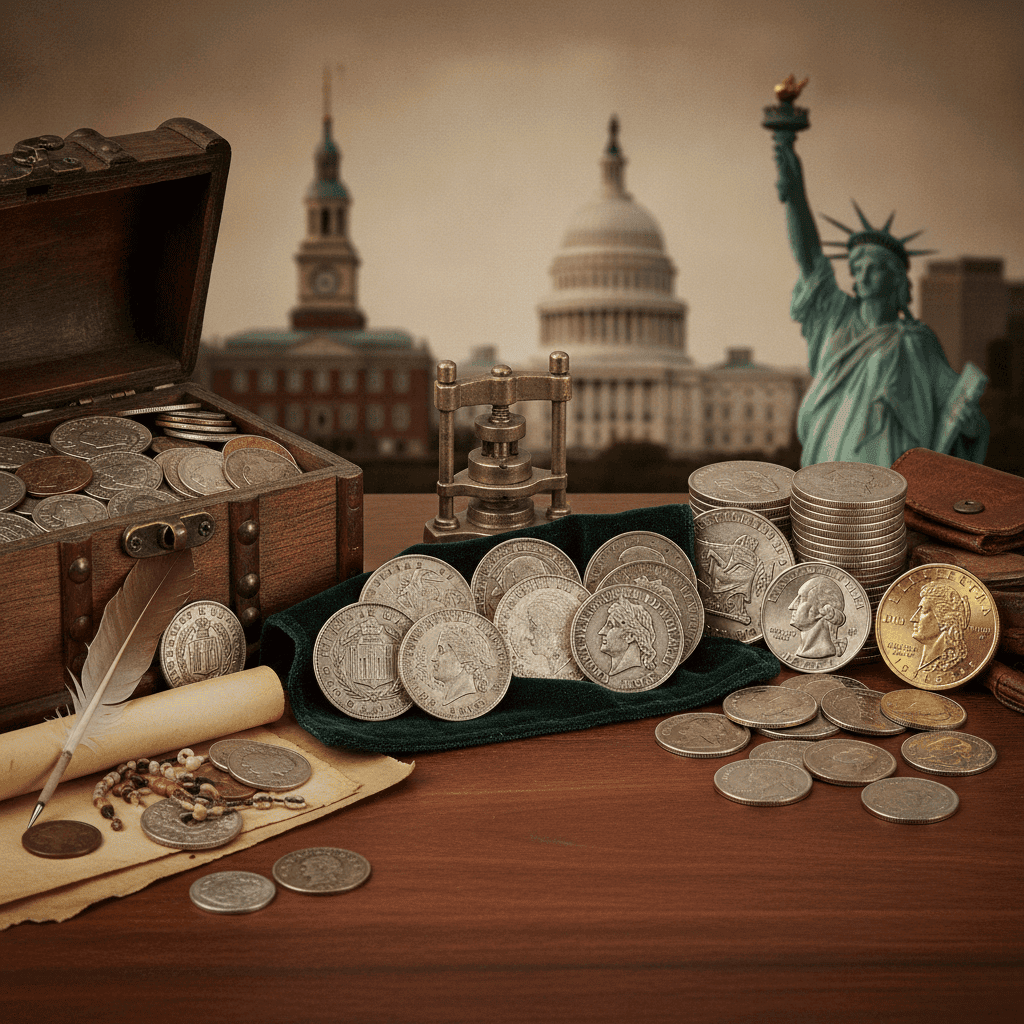
The history of money often tells a deeper story about a nation. It reflects economic struggles, political decisions, and changing social values. When I consider the Historical Context of U.S. Coinage, I see a clear path that mirrors America’s own development, from its humble beginnings as a collection of colonies to a global power.
I find it fascinating how each coin, no matter how small, holds a piece of that journey. From the very first attempts at a national currency to the familiar coins we use today, every denomination has a reason for its existence and a tale to tell. Understanding this history helps us appreciate the stability and complexity of our financial system now.
This journey through U.S. coinage is not just for collectors or economists. It offers insights into practical aspects of commerce and daily life through centuries of American experience. I believe that learning about these foundational elements enhances our understanding of the broader economic environment.
Early Beginnings and Colonial Currency
Before the United States officially formed, the American colonies faced a constant struggle with currency. They used a mix of foreign coins, commodity money like tobacco and beaver pelts, and locally issued paper money. This created a very confusing and inefficient system for trade and everyday transactions.
I can imagine the difficulties merchants and ordinary people must have faced. Trying to conduct business with Spanish dollars, English shillings, and various colonial paper notes, all with different values and levels of acceptance, would have been a daily challenge. Each colony often printed its own paper currency, which led to wildly fluctuating exchange rates and a general distrust in paper money.
The British government also restricted the colonies from minting their own coins, wanting to control their economies. This forced the colonists to rely heavily on what foreign coins they could acquire. Spanish silver dollars, known as “pieces of eight,” became a common and trusted form of currency because of their consistent silver content.
The Continental Dollar
During the Revolutionary War, the Continental Congress issued its own paper money, known as Continental Currency. These notes were denominated in dollars and were meant to finance the war effort. I believe it was a necessary step, but it quickly ran into problems.
Without a strong backing in gold or silver and with too much being printed, the Continental Currency rapidly lost value. This gave rise to the famous phrase, “not worth a Continental.” This early experience with hyperinflation taught the new nation a harsh lesson about the importance of a stable and trusted currency.
The Continental dollar’s failure underscored the urgent need for a unified and sound monetary system once independence was won. Leaders like Alexander Hamilton recognized that economic stability was as important as political freedom. They knew a national currency would be a pillar of the new republic.
The Coinage Act of 1792 and Early Mints
The establishment of a stable national currency was a priority for the newly formed United States. The Constitution gave Congress the power to coin money and regulate its value. This set the stage for one of the most significant pieces of legislation in American monetary history, the Coinage Act of 1792.
I see this act as a foundational moment, giving birth to the monetary system we still recognize today. It officially established the United States Mint and set the dollar as the standard unit of currency. The act also specified a bimetallic standard, meaning both gold and silver would back the currency.
Under this act, the mint was authorized to produce several denominations of gold, silver, and copper coins. These included the copper cent and half-cent, silver half-dime, dime, quarter, half-dollar, and dollar, and gold quarter eagle, half eagle, and eagle. I think the decision to adopt a decimal system was quite forward-thinking for the time.
Establishing a National System
The first U.S. Mint began operations in Philadelphia. It struck its first circulating coins, copper cents, in 1793. The early days were challenging because obtaining enough precious metal to mint coins was difficult.
There was a constant struggle to keep gold and silver coins in circulation. This was because the fixed ratio of gold to silver set by the Coinage Act often differed from market ratios, leading to one metal being hoarded or exported. I learned that this issue would plague the American monetary system for many decades.
Despite these early hurdles, the Coinage Act laid the groundwork for a unified national currency, moving away from the chaotic mix of foreign and colonial monies. It signaled a strong commitment to economic order and national identity. The consistent production of coins, even if scarce at times, reinforced federal authority and facilitated commerce.
Silver and Gold in the 19th Century
The 19th century was a period of intense debate and change for U.S. coinage, particularly concerning the roles of silver and gold. The bimetallic standard set in 1792 created problems because the market value of gold and silver constantly shifted. This meant that either gold or silver coins were worth more as bullion than as currency, leading to their removal from circulation.
I recall studying how this issue caused severe disruptions to the economy. When silver became relatively undervalued at the mint, people would melt down silver coins or export them. Then they would bring gold to the mint to be coined, which meant gold coins were more common. The reverse happened when gold was undervalued. This created periods where one metal virtually disappeared from circulation, leaving the country with effectively a monometallic standard despite the law.
Various coinage acts throughout the 1800s tried to adjust the gold-to-silver ratio to fix this. For example, the Coinage Act of 1834 changed the ratio to make gold more attractive, leading to more gold in circulation. These adjustments were always a delicate balancing act, and I think they rarely achieved long-term stability.
Bimetallism and its Challenges
The issue of bimetallism became a major political and economic debate in the latter half of the 19th century, especially with the “Free Silver” movement. Proponents of free silver argued that unlimited coinage of silver would increase the money supply, help farmers by raising crop prices, and make it easier to pay off debts. I see this as a classic example of economic policy directly impacting daily lives.
The discovery of vast silver deposits in the American West further fueled this debate. Eventually, the United States moved towards a de facto gold standard. Then it officially adopted one with the Gold Standard Act of 1900. This meant that all currency, including paper money, was redeemable for a fixed amount of gold. Many people remember the challenges surrounding silver half dollar years and other silver denominations during these periods of monetary flux.
This shift to the gold standard ended decades of bimetallic instability. It also provided a more predictable monetary environment, which many business interests favored. I have observed that monetary policy is rarely simple and often involves difficult choices.
The Impact of the Civil War on Coinage
The American Civil War had a profound and lasting impact on the nation’s monetary system. The immense cost of the war forced the Union government to implement drastic measures to finance its operations. I learned that these changes moved the country away from its long-standing reliance on precious metal coinage.
Before the war, gold and silver coins were the primary circulating currency. However, as the war intensified and public confidence wavered, people began hoarding these precious metal coins. This phenomenon, known as Gresham’s Law, meant that “bad money drives out good money.” Essentially, undervalued currency (paper) was used for transactions, while more valuable currency (gold and silver coins) was kept out of circulation.
The U.S. government faced a severe shortage of circulating coinage. The federal government needed a way to pay its soldiers and suppliers. This emergency situation led to the introduction of new forms of currency, permanently altering the landscape of American money.
Paper Money and Fractional Currency
To address the coinage shortage and finance the war, the Union government issued “greenbacks,” fiat paper money that was not backed by gold or silver. These notes were legal tender, but their value fluctuated based on the Union’s military fortunes. I can only imagine the uncertainty this caused for ordinary citizens trying to manage their finances.
Furthermore, the hoarding of gold and silver coins extended to even the smallest denominations, like pennies and nickels. This made everyday transactions difficult. To solve this, the government introduced “fractional currency,” which were small paper notes in denominations of 3, 5, 10, 15, 25, and 50 cents. These pieces of paper served as a substitute for small change.
The Civil War era fundamentally changed the public’s perception and use of paper money. While greenbacks and fractional currency were initially born out of necessity, they paved the way for a national paper currency system that would continue long after the war ended. I consider it a critical period where the government’s role in currency issuance expanded significantly.
Modern U.S. Coinage and Design Changes
The 20th and 21st centuries brought significant changes to U.S. coinage, moving away from precious metals and towards more commemorative and aesthetically diverse designs. The global economic shifts and the need for a more flexible monetary policy eventually led to the end of the gold standard in the 1930s and the removal of silver from circulating coinage in the 1960s.
I find it remarkable how coin compositions changed over time. For example, the dime, quarter, and half-dollar, once primarily silver, were replaced with copper-nickel clad coins. This marked a major shift from intrinsic value to fiat value, where the government’s backing determines the currency’s worth. It simplified the minting process and stabilized the supply of coins.
Beyond composition, modern U.S. coinage has seen a celebration of American history and culture through its designs. Iconic figures like Abraham Lincoln on the penny, Thomas Jefferson on the nickel, Franklin D. Roosevelt on the dime, George Washington on the quarter, and John F. Kennedy on the half-dollar became permanent fixtures. These designs connect us to our national heritage every day.
Commemorative Issues and Collecting
A notable trend in modern coinage is the proliferation of commemorative issues. The State Quarters Program, launched in 1999, was incredibly popular. It featured unique designs for each of the 50 states. I recall the excitement as new quarters were released each year, sparking widespread interest in coin collecting among the general public.
Following the success of the State Quarters, other programs emerged, such as the America the Beautiful Quarters featuring national parks and sites. Presidential dollars and innovation dollars also added diversity to circulating coins. These programs not only honored significant figures and places but also served to educate people about American history and geography.
For me, these specialized issues transform ordinary coins into miniature works of art and educational tools. They offer a tangible connection to our nation’s past and its ongoing story. The designs are a testament to our collective memory and our aspirations for the future, making each coin more than just a means of exchange.
Conclusion: The Enduring Legacy of U.S. Coinage
Reflecting on the historical context of U.S. coinage reveals a story deeply intertwined with the nation’s economic and political evolution. From the chaotic colonial exchanges to the precise, standardized coins of today, each era presented unique challenges and innovations. I have come to appreciate the immense effort and foresight that went into creating and maintaining a stable monetary system. It is a system that underpins much of our daily economic life.
The transition from a commodity-backed currency to a fiat system, and the many design changes, illustrate a persistent adaptation to changing circumstances. We see lessons learned from the failures of Continental Currency and the struggles of bimetallism. These experiences paved the way for the robust system we use today. Every coin, whether a historical silver piece or a modern clad quarter, carries a piece of that rich legacy. I believe understanding this history gives us valuable insight into how economic forces shape a nation.
I encourage everyone to take a moment to look at the coins in their pocket. Consider the journey these small metal disks represent. Each one is a silent witness to centuries of American progress and adaptation. Knowing this history helps us become more informed citizens and better understand the economic world around us. Let us continue to learn and appreciate the foundations that support our prosperity.